

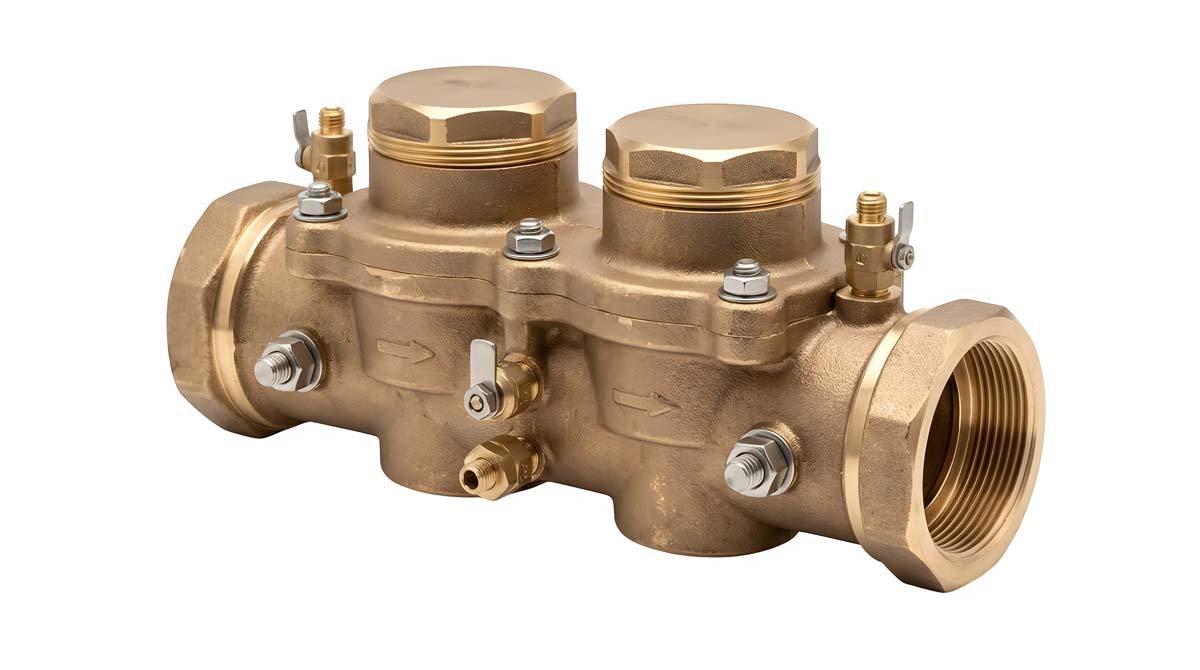
A backflow preventer is one of the few pieces of plumbing whose entire purpose is to do nothing. When it is working, water goes one way and nothing happens. When it fails, it also does nothing, and there is no leak, no noise and no warning light to tell you about it.
That is the whole reason annual testing exists. A backflow assembly is the only safety device in a building that cannot be confirmed as working by looking at it.
What Backflow Actually Is
Water in a building is supposed to flow from the city main toward the fixtures. Backflow is when that reverses and water from inside the building is drawn or pushed back into the potable supply.
It happens two ways. Back-siphonage occurs when pressure in the main drops, usually because of a water main break, a fire hydrant being used, or heavy demand nearby, and the resulting suction pulls water back out of the building. Back-pressure occurs when a system inside the building is at higher pressure than the supply, such as a boiler loop, a booster pump or a pressurised tank, and pushes its water toward the main.
In a house with no connected equipment, neither is likely to cause harm. The problem is a cross connection, meaning any point where the drinking water system touches something that is not drinking water. An irrigation system sitting in soil and fertiliser. A boiler loop with corrosion inhibitor in it. A fire sprinkler system holding water that has been stagnant for years. A commercial dishwasher, a pressure washer, a dental chair, a pool fill line. Each of those is a potential path, and the backflow assembly is what sits between it and the water everyone drinks.
Why These Devices Fail Without Any Sign
Inside the assembly are moving parts in constant contact with water: spring-loaded check valves, rubber seats and discs, and on the higher-hazard types a relief valve that is supposed to dump water if the checks let go.
All of those degrade. Rubber hardens and takes a set. Springs weaken. Grit or a fragment of pipe scale lodges on a seat and holds a check valve slightly open. Mineral deposits build on the internals. None of this produces a symptom you would notice, because the device continues to pass water in the normal direction perfectly well. It has simply stopped being able to stop water going the other way, and you find out when the pressure event happens rather than before.
This is a different proposition from most plumbing failures, which announce themselves. A dripping tap tells you it needs attention. A failed check valve in a backflow assembly tells you nothing at all.
Where You Are Likely to Have One
Backflow protection is required at specific connections rather than everywhere, and the type of device depends on how hazardous the connected system is. Common installations include:
- Irrigation and lawn sprinkler systems, which are among the most frequently found and most frequently neglected
- Boilers and hydronic heating loops, where the make-up water connection needs protection because of the treatment chemicals in the loop
- Fire sprinkler systems, which hold water that is not circulating and often sit on their own assembly
- Commercial kitchens, including dishwashers, pot fillers, carbonated beverage equipment and grease handling
- Pools, hot tubs and water features on a fill line
- Buildings with booster pumps, which is most multi-storey residential and commercial property
- Car washes, laundries, medical and dental equipment, and anything with a chemical injection point
If your property has any of those and you have never seen a test report, that is worth looking into. Devices get installed during construction and then quietly forgotten, particularly on irrigation systems added years after the building went up.
Who Requires the Testing
There are two layers, and the second is the one that generates letters.
The technical standard sits in the BC plumbing requirements, which adopt the Canadian standard covering the selection, installation, maintenance and field testing of backflow preventers. That standard is where the annual testing expectation comes from, along with the requirement that it be done by someone certified to do it.
The enforcement sits with the municipality. Most Lower Mainland cities, including Surrey, White Rock, Langley and Vancouver, operate a cross connection control program under their waterworks bylaw. Under those programs the property owner is responsible for having each assembly tested annually by a certified tester and for filing the report with the city. Failing to do so can lead to penalties and, in the bylaws that provide for it, to the water service being shut off until compliance is restored. The specifics differ between municipalities, so the local bylaw is the thing to check.
For commercial and strata property this usually arrives as an annual notice listing the devices on the city's register. Our backflow prevention service covers testing, repair and the paperwork, which is the part that actually closes the file with the city.
What a Test Involves
It is a short, undramatic visit, and knowing what happens makes scheduling it easier.
A certified tester connects a differential pressure gauge to the test ports on the assembly and closes the shutoffs to isolate it. Each check valve is then tested in turn to confirm it holds against reverse pressure, and on a reduced pressure assembly the relief valve is tested to confirm it opens at the right differential. The readings are recorded against the device's make, model and serial number, and the report goes to the city and to you.
Water to whatever the device serves is off during the test, typically for fifteen to thirty minutes per assembly. For a restaurant, a salon or a building with tenants, that is worth scheduling deliberately rather than discovering mid-service.
If a device fails, most types can be rebuilt with a manufacturer kit and retested the same visit, assuming the parts are on the truck. Devices that are very old, obsolete or corroded internally are usually more sensibly replaced, and occasionally a device that was installed incorrectly in the first place has to be relocated to satisfy the standard, which is a separate job worth knowing about early.
Keep the Records
The administrative side matters more than people expect. Each assembly has a serial number and a history, and the city's register works from that.
Keep every test report, note where each device is physically located, and keep a list of what equipment each one protects. Buildings change hands and property managers change, and the most common reason a device goes untested for years is simply that nobody remaining knows it is there. A device behind a panel in a mechanical room with no record attached to it is the one that fails quietly.
If you are planning renovations or adding equipment, the time to sort out backflow protection is during the design rather than at inspection. We handle this on plumbing and boiler work and on new construction projects, where getting the right device in the right place the first time avoids an expensive correction later.
Book a Test
Hilltop Plumbing and Heating serves White Rock, South Surrey, Langley and the wider Lower Mainland, including backflow testing, repair and replacement for residential, commercial and strata property.
If you have had a notice from the city, or you are not sure whether the devices on your property have ever been tested, call (604) 536-5545 or contact us and we will sort out what you have and what it needs.